Followers

Wednesday, April 17, 2019

Replacing a Delta Bathroom Faucet Cartridge

     Plumbers are expensive.  That's why I decided to replace the cartridge in my leaky bathroom faucet.  I should say "faucets" because I discovered the beginnings of a leak in the faucet of the second sink while fixing the first sink.  I assembled my photo tutorial using pictures from both faucet repairs.  Don't be confused by the left/right switches.


Step 1
The problem was not water leaking out the spout.  The water was leaking from the bottom of the faucet handle.  Water dripping from the spout usually means that the cartridge is worn out.  Water escaping from the handle usually means springs, seats, and O rings need to be replaced.  I decided to replace the whole shebang since this faucet is 10 years old.

Step 2
Gather an adjustable or channel lock wrench, needle nose pliers, an appropriately sized Allen wrench/hex key, and some old towels.  Then complete the most important step - turn off the water.  The shut off valves are under the sink.  Turn off both the hot and the cold sides.

Step 3
Faucet parts can be tiny, so it is important to close the drain stopper.  Your task will be oh so much harder if any parts go down the drain.  Once you have found the Allen wrench that fits, remove the set screw and pull off the faucet handle. 

You have exposed the cartridge and the nut that holds the cartridge down.

Step 4
Use the adjustable wrench or channel locks to remove the nut.  Turn counter clockwise.  It might be fused into place.  Add additional force gradually.

Step 5
Grab the cartridge with your needle nose pliers and pull it up and out.  Note the orientation of the cartridge, and sit it aside in the same position as it sat within the body of the faucet.  You'll see why this is important in Step 8.

Step 6
Use an old towel or rag to absorb any water in the hole.  Insert your finger, and you will find a round, plastic ridge in a well at the bottom of the hole.  This is the seat and there is a spring under this seat.  Use your needle nose pliers to grab the ring and seat and pull them out.

 Here is the old seat and spring.

Crusty Old Parts
Note the O ring on the cartridge.

Step 7
At this point, I used vinegar to remove the mineral deposits under the faucet handles.  They say not to use your finger nails as tools, but I scraped with my nails.  I didn't want to use a hard implement for scraping as that might have scratched the chrome.

Step 8
Cartridges come with a little plastic part that you insert.  Match the position of the plastic part in the new cartridge to the same part in the old cartridge.  The little plastic wedge controls the direction in which the handle turns (and I think whether hot or cold water comes out of the faucet) so you don't want to get this wrong..

Step 9
Place the spring inside the seat (wide end up and narrow end down).  Using the needle nose pliers, place the seat and spring in the well at the bottom of the hole.  You might have to apply some pressure with your finger to get these parts snuggley down into place.

Step 10
Drop in the new cartridge.  Note that the plastic tab on the cartridge must fit into the metal slot on the faucet body.  It might take a little pressure to push the cartridge down as far as it needs to go.

Step 11
Replace the nut tightening only with your fingers.  Once you have tightened it as far as it will go with your fingers, use the wrench to tighten just slightly more.  Tightening too much might damage the new O ring.  Now, replace the handle and tighten the set screw with the Allen wrench.  Turn on the water and check for leaks. 


     This repair cost $36.09.  Each cartridge cost $14.68.  A two pack of seats and springs cost $4.49.  Of course, there was sales tax.  You can get cheaper generic, plastic cartridges, but I decided to buy the brass parts sold at Lowe's that are designated as Delta replacement parts.

Monday, April 15, 2019

Eastern State Penitentiary

     Eastern State Penitentiary, located at 2027 Fairmount Avenue, Philadelphia, Pennsylvania, was operational from 1829 to 1971.  The property was abandoned through the 1980s while the city of Philadelphia considered various redevelopment plans.  The Eastern State Penitentiary Task Force successfully halted redevelopment in 1988, and the prison opened to the public for historic tours in 1994.  The prison is a U.S. National Historic Landmark, and it is open for tours every single day of the year from 10:00 a.m until 5:00 p.m.  I visited using a museum pass, one of many free passes available from the Burlington County Library.
     Eastern State was the first true penitentiary in the United States - a place where people were not  physically punished (whipping, for example), but where they were separated from society and from their fellow prisoners.  They served out their sentences in separate cells.  Prisoners didn't speak to each other.  They did not work together or take meals in a common dining room.  Silence was so important that guards wore socks over their shoes to muffle their footsteps.  This quiet, solitary existence, brainchild of reforming Quakers, was supposed to help offenders reflect, repent, and reform.  No one knows if the system worked because, during the years that the prison operated under this "Pennsylvania System" of separation, there was no record keeping concerning rates of recidivism.  Many people thought the Pennsylvania System merely traded physical tortures for mental tortures.       
   
This impressive wall is 30 feet high and extends another 10 feet below ground.  A neighborhood group tends the beautiful floral display in the front of the prison.

The original floor plan called for seven one story cell blocks radiating like spokes of a wheel from a circular hub.  Before the prison was halfway built, it was apparent that it would not be big enough.  The plans were altered to add a second story of cells on blocks four through seven.  As time went by, additional two story cell blocks were built in the spaces between the original seven until there were fifteen blocks.   

Cells are 8 feet wide and 12 feet long.  The tiny door in the back of the cell leads to an exercise yard.  

Each cell had a toilet and a cold water tap.  There was a rudimentary form of hot water radiant heating.  When the prison opened in 1829, even the White House didn't have indoor plumbing or central heating.  It turns out that having a toilet wasn't as luxurious as you might think.  All toilets flushed at the same time, twice per week, when a prison employee activated the central flushing system.      

Each cell had a skylight.

This cell has been restored to show how it would have looked for the average inmate.  Al Capone was incarcerated at Eastern State Penitentiary for seven months in 1929.  Prison officials allowed Capone to decorate his cell with luxurious furnishings, artwork, expensive rugs, and a radio.  Renovations of Capone's cell are not completed, so I didn't see it.  

Cell Block 4.

Sentences then were both harsher and more lenient than sentences now.  A first time offender might be sentenced to a two year term for stealing a small sum while a murderer got only 8-10 years.  There were no life sentences.  I suppose execution rather than incarceration was the way it went in the early 1800s. 

Each cell had a tiny exercise yard in the back, eight feet wide, like the cell.  Prisoners were allowed to garden and keep pets in their exercise yards.  

The Philadelphia skyline is visible over the walls.


Read more about it:


https://en.wikipedia.org/wiki/Eastern_State_Penitentiary

https://solitarywatch.org/2010/02/27/charles-dickens-on-solitary-confinement-immense-torture-and-agony/

https://www.easternstate.org/explore/exhibits/al-capones-cell

https://www.easternstate.org/press-room/press-releases/numbers-2017


Tuesday, February 12, 2019

Red Shoes

     When I was a kid, my mother kept a pair of red shoes under her bed.  That must have been the place where women of her era lined up their footwear.  The shoes didn't fit her anymore, not after having three babies, so I admired them and wore them during that brief period when I could squeeze my rapidly growing feet into them.  I'm sure my two younger sisters did the same.
     I thought about those pumps when I heard Dolly Parton's song, "Red Shoes."  My mother's shoes didn't have the same confidence building effect as the shoes in the song, but it was still nice to wear them.
     Enjoy the music.


Monday, February 4, 2019

Punxsutawney Phil Said Spring Would Arrive Early

     Punxsutawney Phil said spring would be early this year, but who thought it would arrive 48 hours later?  Let's hear it for sweat shirt weather.


Monday, January 28, 2019

For the Birds

     Crocheted items are not just for people.  They can also be for the birds.  The South Jersey Crochet Guild recently received a huge amount of donated cotton yarn.  Cotton yarn doesn't lend itself to our usual projects - baby items, hats and scarves, and afghans.  It's great for making dish cloths or wash cloths (and we are filling a request from a shelter for the homeless for wash cloths).
     As I said, we have "a huge amount" of cotton yarn.  We had to find something to make besides wash cloths.  A little googling reveled that wildlife refuges use crocheted nests to rehabilitate birds and other injured or abandoned animals.  Rescues will take cotton nests as an alternative to acrylic.  Yarn nests are soft.  They are superior to the plastic containers sometimes used as nests because animals that might flail around don't aggravate their injuries if they bump into the sides of a crocheted nest.  It's easy to toss cotton nests into the washing machine when they get dirty.  I found two rescues that are thrilled to receive our nests.
     There are free patterns online for bird nests.  Bev's Country Cottage (not me, another crafty Beverly) provides instructions for knitted, crocheted, and loom knitted versions.  Here's the link:

http://bevscountrycottage.com/nest.html

     I just can't resist the urge to tweek a pattern.  Here's my version:

Bird's Nest in Two Sizes

Small Nest

Use two strands of yarn. 
Keep your work tight so birdie toes do not get caught in the nest.
Use H hook 

Don't worry too much about the stitch count.  If, at the end of a round, you don't have exactly 12, 24, or 36 stitches, don't fret.  If you are short on stitches, just increase and go on.  There is no need to decrease if you have an extra stitch.  Being close to the stitch count will produce a nice nest.

R1 : 12 sc into a magic ring.  Join with sl st into the first st. (12 sc)  Pull the ring tightly closed.

R2 : Ch1, do not turn.  2 sc in all 12 sc below for total of 24sc.  Place marker.

NOTE: Do not turn and do not join rounds unless indicated.

R3 : Sc in each sc.  Place marker (24 sc). 

R4 : (2sc in next st, sc in next st) around.  Place marker (36 sc).  Nest bottom should be 3" - 3½" in diameter. 

Rds5-7 : Repeat R3 (36 sc) marking all rounds with the marker.

After R7, turn the nest inside-out.  It is easier to weave in and clip the beginning strands before turning the nest 

Continue making 4 more rounds using your marker or until the nest is 2½ to 3 inches deep.  You can finish off with an edge of slip stitching, but it is not necessary.  Clip yarn and weave ends.   


 For a larger nest: After R4 do another round of 2sc, 1sc to reach a total of 54 sc.  The bottom of the nest will be 4½" - 5" in diameter.  Repeat Rds5-7.  Turn nest inside-out.  Complete 5 rounds of 54sc.  Sides should be about 3" high.  This nest will benefit from a round of slip stitch at the rim to add stability.  Clip yarn and weave in ends.  

Birds don't care about the color.  Making these nests is a great way to use up all your scraps of yarn. 

The most used size has a 3.5 to 4.5 inch bottom diameter, but nests with a bottom diameter of up to 6.5 inches are useful.


Tuesday, January 15, 2019

The National Survey on Drug Use and Health

     I received a letter yesterday from the United States Department of Health and Human Services which informs me that my address is one of 200,000 randomly chosen for participation in the National Survey on Drug Use and Health.  The letter looked official.  It was signed by Grace E. Medley, National Study Director, and Ilona S. Johnson, National Field Director.  Both of these ladies work for RTI International, a non-profit organization contracted to conduct the study.  An interviewer named Theresa Albino would come to my house to conduct my survey interview.  There was a picture showing a sample of the badge that Ms. Albino would wear as a way of confirming her identity.  The letter also referred me to a website (https://nsduhweb.rti.org/respweb/homepage.cfm) and provided a toll free phone number (1-800-848-4079).  As an incentive, I would even be paid $30.00 in cash if, after answering some basic questions, I were to be chosen to complete the full survey.  Of course, I spent an hour googling to determine if this was for real.  Turns out it is.

https://en.wikipedia.org/wiki/National_Survey_on_Drug_Use_and_Health

     Now, I don't have problems with government surveys like the decennial census.  In fact, I worked as a census taker in 2010.  The National Survey on Drug Use and Health has been conducted every year since 1971.  RTI International got the job of conducting the survey in 1988.  The survey includes questions about use or non-use of tobacco, alcohol, and drugs.  There are also questions about mental health and other health related topics.  After the initial screening, the household might be by-passed for participation.  If the household is selected for full participation, only one member will be interviewed, and that member might be a child age 12 or older.  If there is one thing I have observed in life, it is that everybody lies.  I'm willing to bet that almost everybody minimizes how much they smoke and drink, and they might increase the deception when it comes to revealing drug use and their mental health struggles.  I would almost be willing to bet my next Social Security check that a fourteen-year-old would tell the biggest whoppers of all, especially if their parents are in the room.  RTI International makes assurances that participants' information is completely confidential, but they know that this promise isn't always enough to extract the complete truth.  According to a report I read from the 2016 survey, RTI randomly samples respondents in an attempt to verify their answers.  The quote below comes from that report:               

     "Samples of respondents who completed screenings or interviews are randomly selected for verification. These cases are called by telephone interviewers who ask scripted questions designed to determine the accuracy and quality of the data collected. Any case discovered to have a problem or discrepancy is flagged and routed to a small specialized team of telephone interviewers who recontact respondents for further investigation of the issue(s). Depending on the amount of an FI's work that cannot be verified through telephone verification, including bad telephone numbers (e.g., incorrect number, disconnected, not in service), a field verification may be conducted. Field verification involves another FI returning in person to the sampled address to verify the accuracy and quality of the data."

     Verification problems might be caused by the participant changing a story or the participant might not want to talk about sensitive information with an unknown caller.  There is also the possibility  the interviewer fabricated answers to get the job done when participants won't cooperate.  The report goes on to explain that, should it come to light that the interviewer lied, they will be fired from their job.  You can read the full report here:

https://www.samhsa.gov/data/sites/default/files/NSDUH-MethodSummDefs-2016/NSDUH-MethodSummDefs-2016.htm

     Participation in the U. S. Census is mandatory under Title 13 of the U.S. Code.  You can be fined for failure to participate or for answering questions falsely.  However,  participating in the National Survey on Drug Use and Health is voluntary.  I don't have much to report to the Department of Health and Human Services other than having wine with dinner and popping the occasional ibuprofen when I work too hard in the yard.  None the less, I have decided to "just say no." 


Monday, January 7, 2019

Baby Blankets with Coordinating Hats

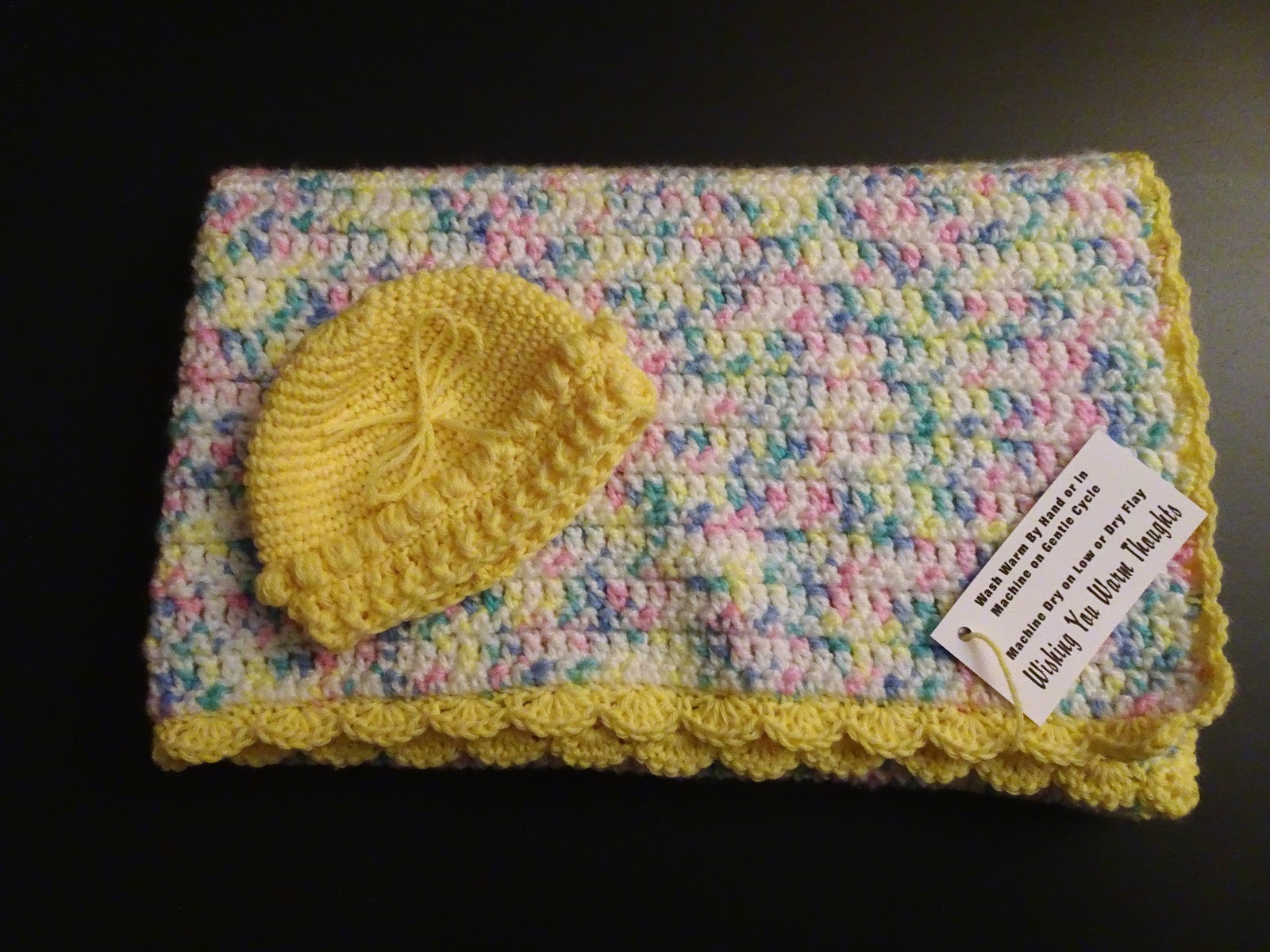
     The Crochet Guild of Southern New Jersey got a request from another local organization for baby blankets with matching hats.  Since we rely on yarn donations, often there is not enough yarn to complete a project.  Sometimes we receive weirdly colored yarn or yarn composed of unusual fibers.  Here are my contributions so far to this project:

This yarn is very soft, good for babies, but the colors are not traditional.  The fiber content is 50% rayon from bamboo and 50% rayon from another source.  Rayon is also known as viscose.  Ordinary rayon is made from regenerated wood cellulose, and bamboo rayon is made from the regenerated cellulose of the bamboo plant.  Bamboo rayon is pretty much the same as regular rayon.  Regeneration refers to the chemical change that happens to the cellulose when it is processed.  Processing bamboo cellulose involves steaming and crushing the plant then treating the cellulose with lye and carbon disulfide.  Emissions from this process cause air pollution and damage the heath of textile workers.  If you think that fabric made from bamboo is natural, made in the same way as cotton, linen, or wool, think again.  Bamboo rayon is neither natural nor artificial.  To see that something is made from bamboo sounds "green," but the processing is far from a "green" operation. In China, bamboo replaced wood cellulose for rayon production because bamboo grows quicker.  The bamboo forest renews itself faster and can grow in poorer soil than a normal forest.  While the antimicrobial properties of bamboo are questionable, the fabric is biodegradable and can be composted when it reaches the end of its serviceable life.   

There wasn't enough of this multi-colored acrylic yarn to make the blanket, so the edges are multi-colored and the center is done with white yarn.  The yellow edge brings the yellow hat into the mix.  I could go on about acrylic fiber because it is made from petroleum, but I have always known that.  The bamboo yarn story was eye opening to me, and I thought it might also be for H in H readers.  


     Note: I always wash the finished projects since the source of the yarn is almost always unknown.