Hamburgers are for Memorial Day, but I had a hankering for a turkey burger. I found a recipe at Allrecipes.com that sounded good. Their recipe used three pounds of meat. I had only 1.3 pounds of ground turkey, so I adjusted the recipe. I also made some little tweeks to the mix.
Here's the link to the Allrecipe's site: https://www.allrecipes.com/recipe/39748/actually-delicious-turkey-burgers/
Here's how I made my burgers:
I got a bowl and mixed up -
1.3 lbs. lean ground turkey
1/8 cup one minute oatmeal (substitute for seasoned bread crumbs)
A couple of shakes of Italian seasoning (because I didn't use the seasoned bread crumbs)
1/8 cup finely diced onion - less if you don't love onion
1/8 cup egg white
About 1 tsp. dried parsley
1 very small clove crushed, fresh garlic
A scant 1/2 tsp. of salt
Freshly ground black pepper to your taste
Cook in a medium skillet, turning once. Allrecipes recommends cooking to an internal temperature of 180°. I also found another recipe that recommended cooking to an internal temperature of 160°. Just cook it until it's well done but not dried out. I melted pepper jack cheese over my burger before wrapping it in a bun.
Weather wise this was a lousy Memorial Day, and I couldn't detect the smell of grilling anywhere in the neighborhood. I'm betting that these burgers would be even better hot off the grill.
Wednesday, May 30, 2018

Saturday, May 26, 2018
Wednesday, May 16, 2018
Unexpected Surprise
I was in Philly today for a checkup after December's Mohs surgery which treated skin cancer on my schnoz. I thought having lunch at Parc on Rittenhouse Square would be the highlight of the day. Having lunch at Parc while watching Henry Winkler have his lunch just a couple of tables away - now that's a high point.
I haven't paid much attention to Henry Winkler since "Happy Days" and "Night Shift," so my lunch companion, a big fan of Winkler's travel show "Better Late than Never," would have to be the one to approach him. She says he was quite gracious, extending his hand immediately to greet her. After some brief conversation, she left him to his lunch.
We wanted to be cool and not heckle the celebrity too much, but damn I wish we had gotten a selfie.
Monday, May 14, 2018
Sky-Blue Pink
From time to time I beg for craft supplies. After using a bunch of leftover quilt batting for my Ikea chair restoration, I decided to use fabric and batting scraps to make quilts for cats at local animal shelters. The shelters take knitted and crocheted blankets for cat cages, and the animals take these blankets with them when they go to their adoptive homes. Maybe the shelters would also accept little, patchwork quilts. While I have an abundance of fabric and batting, there is a scarcity of thread around here. I put out the word that I would love to have old, partially used spools of thread. Any color would do, even sky-blue pink.
That was one of my father's expressions.
"What's your favorite color, Dad?"
"Sky-blue pink."
"What color is that?"
"Look at the sky."
"I don't see any pink. It's just blue"
"You will. Keep looking."
I have met my fair share of people from various backgrounds, read a lot of books and watched a lot of movies and television, and I have never heard anyone use the term sky-blue pink except my father. How did this expression enter Dad's vocabulary?
The term first appeared here, in the United States, in the late 1800s, in clothing advertisements. It was used to indicate that there was a large range of colors available for sale. Later the term sky-blue pink was used by Howard R. Garis in "Sammie and Susie Littletail," a children's story that he wrote in 1910. Other children's authors picked up the term and included it in their writings.
By the 1930s, the Brits got hold of the expression and further embellished it. British versions include sky-blue pink with purple dots, sky-blue pink with yellow spots, and sky-blue pink with a heavenly border. Since my father was billeted in an English boarding home during part of World War II, I'm betting he picked up the phrase from his landlady, a woman of whom he grew fond and with whom he corresponded for many years after the war until her death.
Thanks to World Wide Words for the following article:
http://www.worldwidewords.org/qa/qa-sky1.htm
Friday, May 11, 2018
I Swore I Would Stop Trash Picking
I swore I would stop trash picking until I saw an interesting chair out there on the roadside. I asked permission to take it, and its owner gave it to me. I discovered that this gem was from Ikea. That means that it would be a snap to disassemble and re-assemble my find. Most Ikea furniture comes flat packed. The stuff is engineered to be easy to put together.
 |
| Here is my chair, just the frame. It is very solid, but it is missing its cushion. |
 |
| I suppose the correct tool would have been a hex wrench, but this star wrench worked. I began taking things apart. |
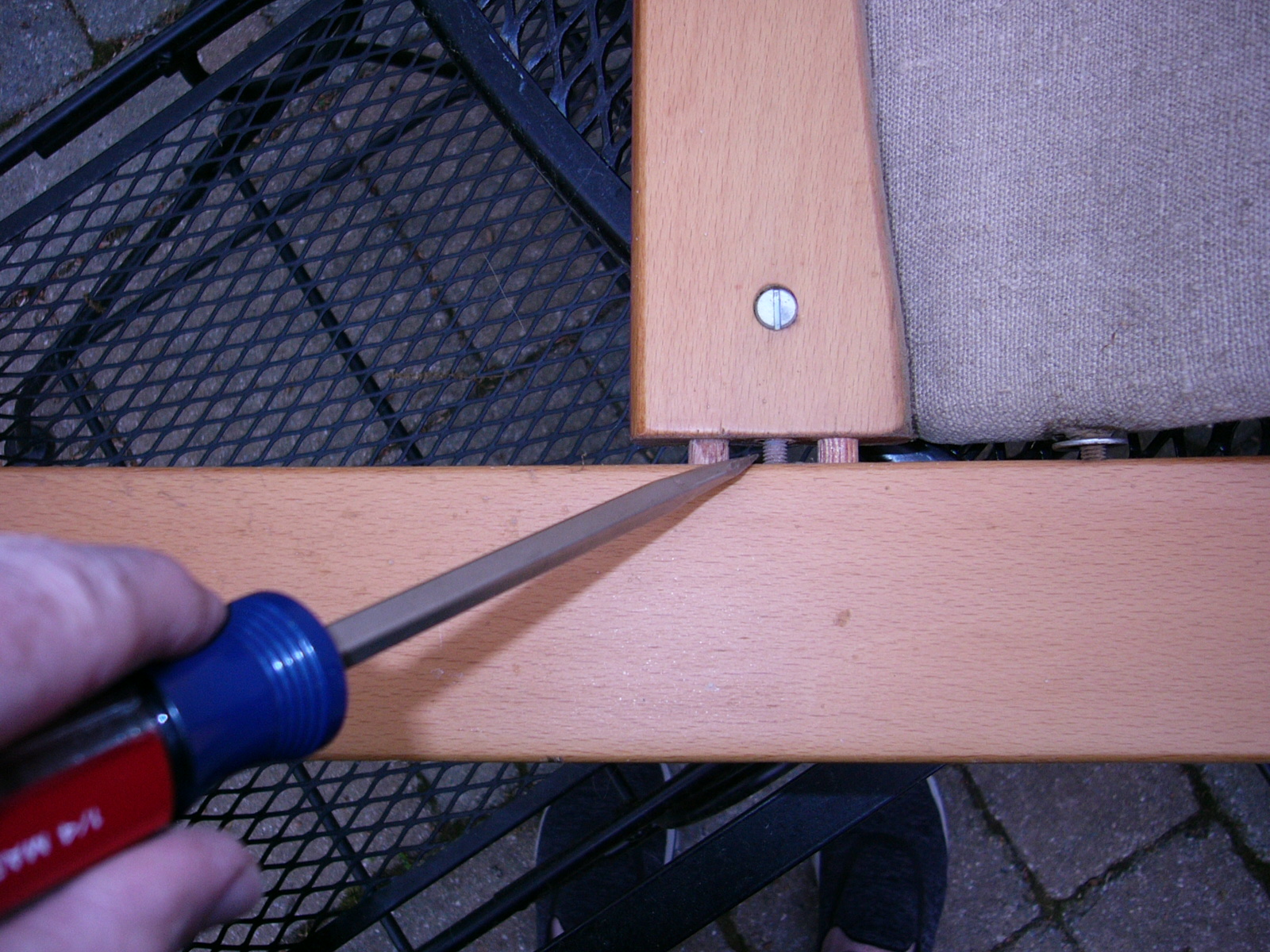 |
| Hmm....What's going on here? |
 |
| The joining requires two dows and a three piece screw assembly. Interesting. I separated all of the wood pieces and washed them with Pledge Wood Cleaner. There was a nice finish under a layer of pollen. |
 |
| Now I have a metal frame covered in a canvas or jute fabric. I cut the fabric cover along the seams, so I could make a paper pattern. |
 |
| This is what was underneath - the frame and a mesh seat. I decided the sand off a little rust and to spray with gray primer. |
 |
| I didn't want to get paint on the mesh, so I covered it with cardboard. |
 |
| I decided just a coat of primer would do. |
 |
| The cover is just a fabric tube with the seam going up the center in the front. The bottom of the tube is sewn shut. The top is open. You put the fabric cover on the metal frame like stuffing a pillow into a pillow case. |
 |
| I made a paper pattern. I had around four yards of linen-look decorator fabric in my stash. Perfect. |
 |
| I decided to cover the mesh seat so the dark color wouldn't show through. |
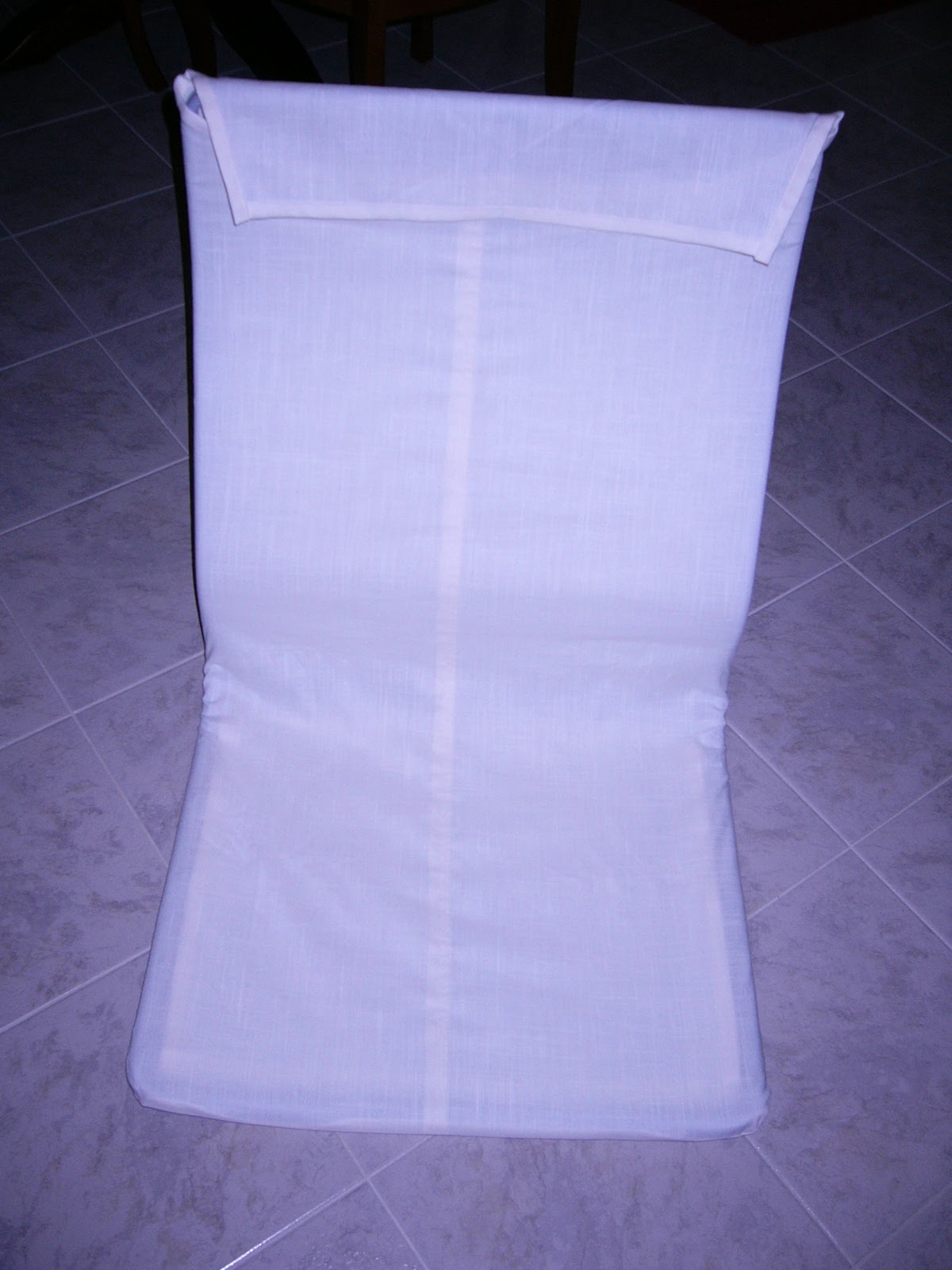 |
| This is the new cover for the frame. |
 |
| I put the chair together and ruminated on what sort of cushion to make. |
 |
| I went up into the attic and grabbed a giant garbage bag full of left over quilt batting. I cut out and stacked several layers of batting for the seat cushion, back cushion, and head rest. Then I made a giant pillow case. I stuffed the bottom of the fabric tube with the stack of batting cut to seat cushion size. I sewed a seam across the top of this segment to encase the batting. Then I inserted the pile of batting that would serve as the back cushion and sewed a line of stitching across the top of this segment. Finally, I stuffed the head rest, turned the excess fabric on the edge inward, and closed the top seam. The original cushion was attached with a strip of velcro, but I didn't have any velcro. I added a tie on each corner to attach the cushion to the frame. This chair cost $0.00 to refurbish since all the material used is leftovers from past projects. |
Wednesday, May 9, 2018
Easy Temporary Clothes Rack
A friend of mine once made me a clothes rack that I used at my yard sales. The rack cost $0 to build because it was made from scraps. It assembled and disassembled in seconds and could be stored lying flat on the floor or standing upright in a corner. I used it for years. Eventually, I gave it to an admirer who used it to hang heavy winter gear in the attic.
The beauty of this item is that pressure is the only thing that holds it together. It is heavy enough that a good wind will not blow it over yet it is light enough for just about anyone to manage.
Here are the instructions:

The beauty of this item is that pressure is the only thing that holds it together. It is heavy enough that a good wind will not blow it over yet it is light enough for just about anyone to manage.
Here are the instructions:

Thursday, March 29, 2018
Name or Weather Forecast?
If you read Happy in Hainesport, you know I am a Randy Rainbow fan. One of the first things I googled when I discovered Randy's parodies was, "Is Randy Rainbow his real name?" Turns out it is. Yesterday, I read that Caroline Sunshine is joining Donald Trump's press team. So, I had to google, "Caroline Sunshine + real name." Darned if that isn't the name on her birth certificate.
My work was cut out for me. I had to know how many people had meteorological names. I discovered that, while there are a lot of surnames that describe atmospheric conditions, the origin of those names might not be related to the elements.
For example:
Air - This is an Anglo-Saxon name given to a person who inherits an estate, title, or fortune. It is also a name given to a Norman knight who cleared the airway of William of Normandy when he was in danger of suffocation during the battle of Normandy Some variations of the name are Eyre, Eayres, Ayer, Hayer, and Hoyer.
Breeze - Breeze was originally a nickname for an annoying person. The nickname comes from the Old English word "breosa," a gadfly. This name might also have developed from the Welsh name Rhys.
Cloud - Cloud is a Scottish name that is derived from the given name or first name Leod, Mac Leod would be the son of Leod. Eventually, Mac Leod became Cloud.
Snow - Snow was a nickname for a person with white hair or a very pale complextion.
Ice - This surname might have been derived from the first name Aigo. Aigo is derived from the German word ecke which means "sharp sword blade." Then again, the surname Ice could have come from the first name Ico, a name popular in northern Germany and the Netherlands.
Thunder - This name was first recorded in England and Ireland. There are two possible origins of the name. It could have come from the French word tundeur which means a person who shears or manufactures shears. Another possible origin is from the Old English word tunder, a worker who poured wine into tuns, the large barrels used for transporting alcoholic beverages.
Surnames developed during the Middle Ages when populations grew and people needed a way to distinguish one Alfred from another Alfred. I don't know if we have all the surnames we will ever need or if new ones are still popping up. In keeping with the climate theme I would like to suggest Suzy Lake Effect, Patsy Prevailing Wind, or maybe Virginia Gustnado.
Subscribe to:
Posts (Atom)